
Why we do not conduct competitive matches
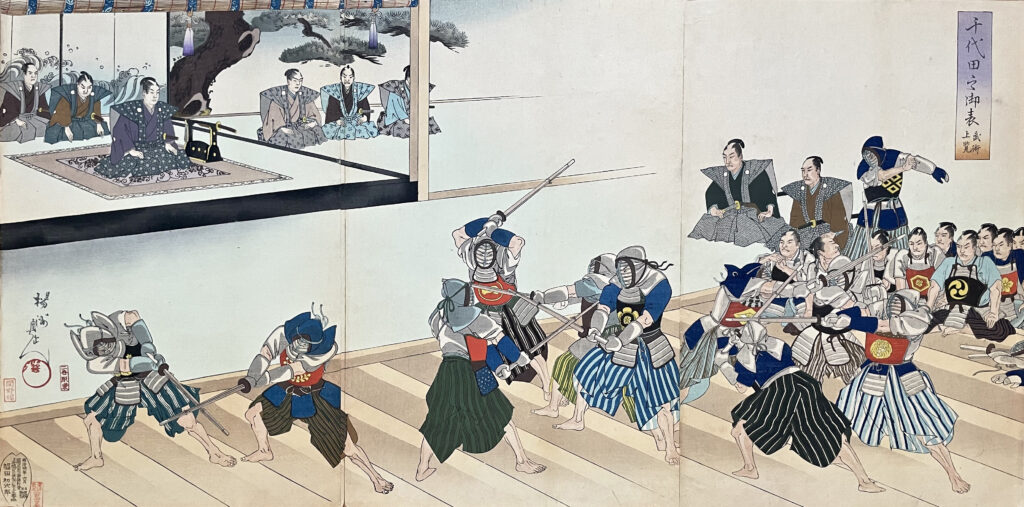
I recently read a fascinating paper titled “Activities of the Gekiken Club at the Former First Higher School: The Proposal of Mukensho-shiai” (Hiroya Sato, 2024) on J-STAGE.
According to this research, during the formative years of modern Kendo, there existed a concept called Mukensho-shiai (matches without external verification). Proposed by Shioya Tokitoshi of the Hokushin Itto-ryu and adopted by the First Higher School’s Gekiken club, these matches were conducted without referees. The practitioners themselves were responsible for judging the validity of each other’s strikes.
The guiding philosophy was as follows:
“Mukensho means that we, as individuals with distinct character, become self-aware and take responsibility for our own actions. It fosters a spirit of recognizing oneself correctly, making one’s own righteous judgments, and carving one’s own path, free from the coercion of others.”
For these students, Kendo was not “swordplay for the sake of winning” nor merely “combat technique”; it was “Kendo for the sake of scholarship.” It aimed to cultivate independent human beings capable of self-awareness and proper judgment.
Why the Tokyo Gekiken Club Does Not Use Referees:
While the Tokyo Gekiken Club does not claim such high-minded academic ideals, we also do not utilize referees to determine victory or defeat in our free-sparring (Shinai-uchi). Our primary reason is to prevent the development of “sport-specific” movements.
Whenever a “match” is established, certain criteria for winning must be set—be it a point system like modern Kendo, pinning an opponent, or even aesthetic scoring similar to gymnastics or figure skating.
The moment these rules are established, the rule itself becomes the goal. The presence of a referee inevitably leads to “appealing” movements designed to catch the official’s eye. Once this happens, the original purpose of the martial art is lost. No matter how much one speaks of Ki-Ken-Tai Ichi (unity of spirit, sword, and body), if the goal is simply to land a point, the integrity of the movement begins to collapse. Practitioners start using “flicking” strikes from the wrist while retreating, or charging in recklessly even when the opponent’s blade is clearly in contact with their body, simply because they “won’t be hit” according to the rules.
We strive for a form of Gekiken that avoids this trap.
The Accuracy of Self-Judgment
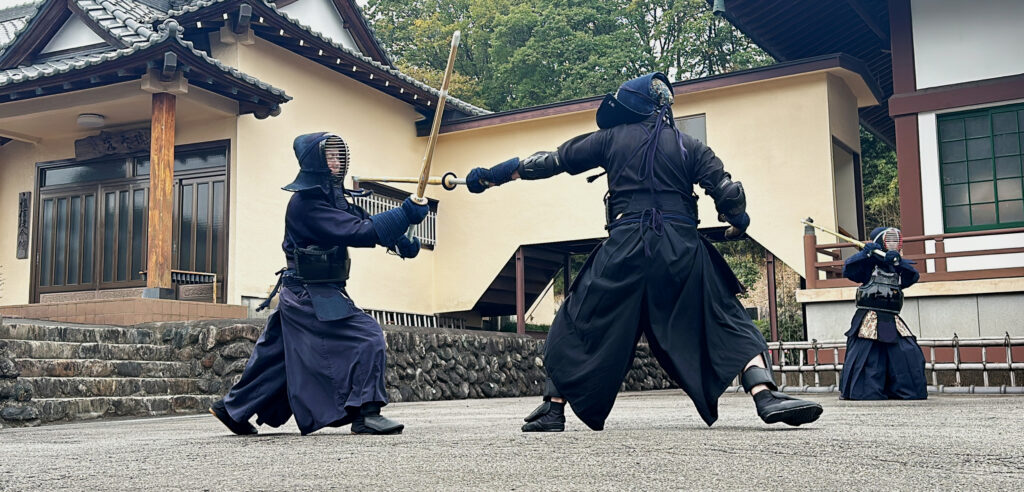
Even without a referee, the reality of a hit is clear to both practitioners. In fact, the practitioners themselves are often more accurate than any external observer. If your goal remains true, you can judge yourself: “That hit landed, but it was just a surface flick and wouldn’t have cut,” or “Was that throw technically sound?”
To maintain this state, one must possess a calm mind—fighting with enough composure to avoid becoming overheated or lost in the moment.
Since this is a martial art (Bujutsu), the task of landing a decisive blow before the opponent remains paramount. We do not practice with the sloppiness of “it’s okay to be hit.” As long as it is Bujutsu, the mindset of “taking the opponent before they take you” must never be forgotten.
Achieving this balance is incredibly difficult, and the path is steep. However, we believe that striving for this level of self-honesty is the ideal state required in martial arts.
Respect and Manners: A Return to Tradition
History shows that during the Bakumatsu period, when Shinai-uchikomi became popular and warriors traveled to various dojos for Musha-shugyo (warrior pilgrimages), referees were rarely present. According to “Diary of a Journey for Swordship Training” (Yoshio Nagai, 2023), there was an atmosphere where practitioners would reflect on their own performance and simply recognize, “That person was skilled; that person was strong.”
The paper on the First Higher School also notes that early swordsmen exhibited a “humble and refined attitude.” Even without referees, there was a “code of manners” in inter-school matches based on mutual respect and recognition.
This is exactly the atmosphere we aim to cultivate.