
The History of Kenjutsu and Gekiken
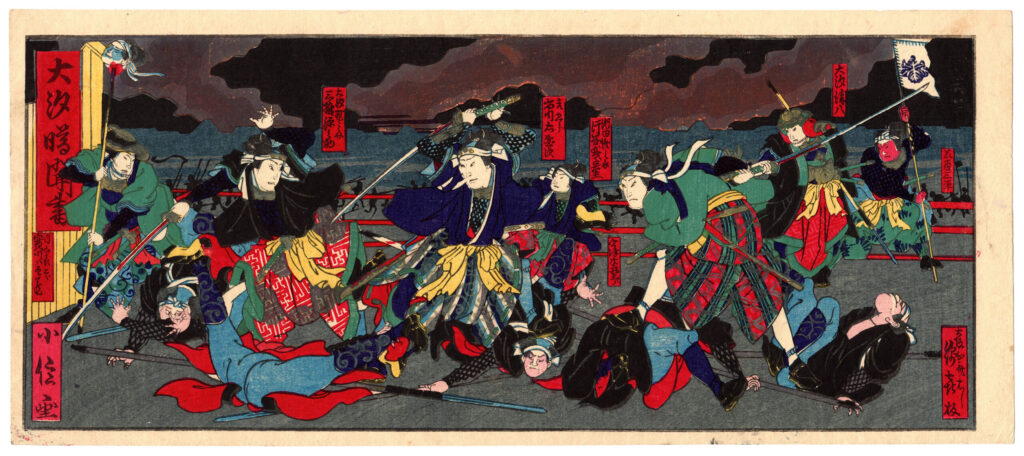
In ancient Japanese mythology, Japan was known as Kuwashi-hoko-chitaru-no-kuni (the land where fine weapons abound), suggesting that swords and various weapons existed since the Age of the Gods.
According to the Nihon Shoki (Chronicles of Japan), during the reign of the 10th Emperor Sujin, Prince Toyoki-irihiko-no-mikoto reported a dream to the Emperor: “At dawn, I climbed Mt. Mimoro, faced the east, and performed hoko-yuge (thrusting spears) and tachi-kaki (striking swords) eight times.” The term tachi-kaki is regarded as one of the earliest terms referring to what is now called kenjutsu (the art of the sword).
The domestic manufacture of swords is said to have begun around the 5th century at Kashima, where the deity of war is enshrined. Kunazu-no-Mahito reportedly received the “Sword of Kashima” through divine revelation. While burial goods from the Kofun period consist mostly of chokuto (straight swords), the craftsmanship was already highly advanced, using complex combinations of hard and soft steel, forming the technical foundation for the later evolution into the wanto (curved sword). The manufacturing method of the Japanese curved sword, featuring structures such as the characteristic curvature and shinogi (ridge line), was established around the late 10th century.
Formal kenjutsu schools (ryuha) began to emerge during the Nanboku-cho and Muromachi periods. Prior to this, sword techniques appeared only fragmentarily in military epics such as The Tale of the Heike and Taiheiki. Below is an overview of the evolution of these arts and their equipment.
The Nanboku-cho to Mid-Muromachi Period (c. 1336–1490)
Major lineages established during this era include the Joko-ryu (succeeding the Kashima lineage), Shinto-ryu, Chujo-ryu (derived from Nen-ryu), and Kage-ryu (founded by Aisu Ikosai, which later gave rise to Shinkage-ryu). Most modern schools can ultimately trace their origins back to these traditions.
During this time, bamboo practice swords (shinai) did not yet exist. Practitioners trained with wooden swords (bokuto) or even tree branches. Because full-force strikes were dangerous, training was conducted with controlled stopping just before impact or with light contact. Even in encounters using unsharpened blades or wooden swords, serious injury, permanent disability, or death could occur.
Mid-Muromachi to Sengoku Period (c. 1490–1570)
From traditions such as Shinto-ryu, Kage-ryu, and Chujo-ryu emerged renowned swordsmen including Tsukahara Bokuden (Kashima Shinto-ryu), Kamiizumi Nobutsuna (Shinkage-ryu), Toda Seigen (Toda-ryu kodachi), and Ito Ittosai (Itto-ryu).
During this period, wooden swords remained the primary training tool. However, Kamiizumi Nobutsuna devised a precursor to the modern bamboo sword known as the fukuro-shinai. This innovation allowed practitioners to retain the feeling of striking while training more safely. The concept of the fukuro-shinai had a significant influence on the later development of the bamboo sword and contributed to the spread of more active and direct forms of paired practice using weapons.
Azuchi-Momoyama to Early Edo Period (c. 1570–1640)
This was a period in which the students and subsequent generations of the aforementioned masters were active.
Among the disciples of Kamiizumi Nobutsuna of Shinkage-ryu:
- Yagyu Muneyoshi (Sekishusai) and his descendants (including Munenori and Hyogo), forming what is known as Yagyu Shinkage-ryu
- Hikita Bungoro and his followers
- Marume Kurando (Taisha-ryu)
Among the disciples of Ito Ittosai:
- Ono Tadaaki (instructor to the Shogunate)
- Kotoda Kageyu
During this time, schools such as Jigen-ryu in Satsuma also emerged, and Miyamoto Musashi was active in this period.
From around this time, the fukuro-shinai gradually spread throughout the country and began to be used across various schools. New traditions were established and disseminated in different regions. Hikita Bungoro is said to have traveled throughout the country, engaging in inter-school matches using the fukuro-shinai.
As the age of warfare came to an end and the Edo period brought political stability under the shogunate system, practical battlefield swordsmanship gradually became less essential. The character of the warrior class softened, and there was a tendency for swordsmanship and martial arts to place increasing emphasis on refinement and form, with practical effectiveness becoming secondary.
Mid-Edo Period (c. 1650–1780)
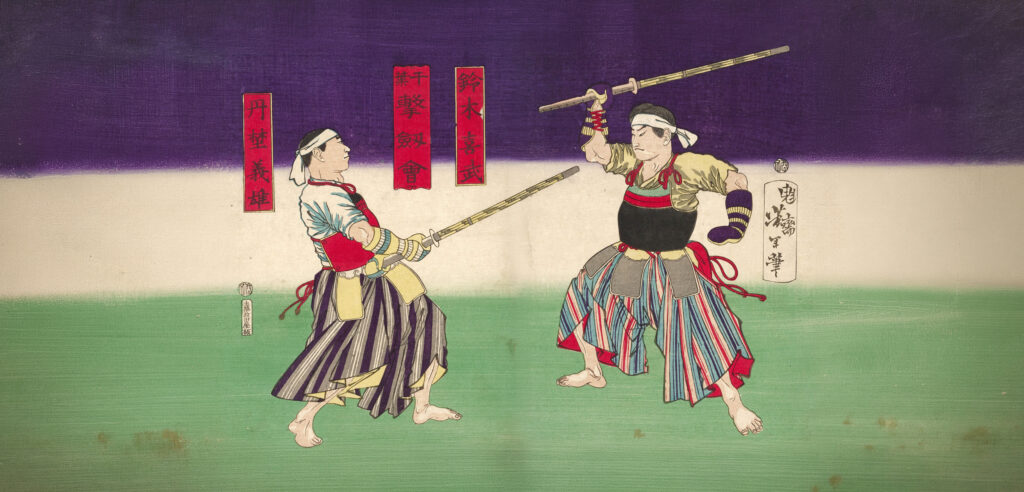
During this period, schools such as Jikishinkage-ryu and Nakanishi-ha Itto-ryu played a central role in the spread of sparring using protective equipment (bogu) and bamboo swords (still in the form of fukuro-shinai). Other schools that would later be active toward the end of the Edo period, such as Shingata To-ryu, Shinto Munen-ryu, and Kyoshin Meichi-ryu, also emerged around this time.
The number of practitioners from outside the samurai class increased, and new schools arose from these social groups. These non-samurai traditions tended to engage more freely in inter-school matches (taryu-jiai). Training journeys involving uchikomi-geiko with bamboo swords also became widespread. Although such journeys were in principle prohibited, they were often carried out under the pretext of religious pilgrimages, such as visits to the Ise Grand Shrine.
During this period, the form of equipment varied depending on the school and region, and techniques displayed a wide range of characteristics.
Tennen Rishin-ryu was founded in the latter half of the mid-Edo period, and in the context of the times, it is understood to have adopted from the outset a teaching system centered on striking practice using bamboo swords and protective gear.
Late Edo Period to the Meiji Restoration (c. 1780–1870)
During this time, influenced by Oishi Susumu, longer bamboo swords became popular, which led to the standard length used today. Protective equipment was also improved, including robust iron-faced masks with thirteen bars, bamboo torso armor, and highly mobile forms of kote resembling those used today.
From the late Edo period into the Meiji era, sparring with bamboo swords became central to the training of swordsmanship. Depending on the region, what was called kenjutsu was also referred to as gekiken, as can be observed in documents from the time. Inter-school matches became common, and interaction between different traditions increased. As a result, techniques across schools began to resemble one another, as they gradually converged toward those effective within bamboo sword sparring.
Kobusho (Shogunate Military Training Hall)
Under the pressures brought by the arrival of Commodore Perry, the Tokugawa shogunate came to recognize the value of practical training methods such as gekiken and spear techniques. Through the initiative of Abe Masahiro, Tokugawa Nariaki of the Mito domain submitted proposals to the shogunate, leading to the establishment of the Kobusho.
At the Kobusho, training centered on striking practice with bamboo swords. It was here that the length of the bamboo sword was standardized to approximately 3 shaku 8 sun, very close to that of modern kendo. The intensity of training also led to further improvements in protective equipment.
This development made it possible to deliver strikes without restraint, advancing the pursuit of realism in bamboo sword training.
Meiji to Early Showa Period (c. 1870–1940)
With the promulgation of the Haitorei (Edict Abolishing the Wearing of Swords), the era of the samurai came to an end, and the practical necessity of martial arts such as swordsmanship declined. In response, efforts were made to preserve these traditions, including public demonstrations of gekiken organized by Sakakibara Kenkichi.
Following events such as the Satsuma Rebellion, swordsmanship was reassessed and began to be actively practiced within institutions such as the police. There were also movements to systematize martial training into group instruction, incorporating it into educational settings and military training.
Dai Nippon Butokukai
Around 1895, an organization of martial artists known as the Butokukai was established. Within this framework, the art came to be formally designated as kendo.
The Butokukai established a system of titles such as renshi, kyoshi, and hanshi, which carried significant social authority. In many dojo across the country, training based on standardized forms established by the Butokukai (equivalent to what is now known as Nihon Kendo Kata) and sparring practice came to be emphasized over the traditional kata of individual schools.
Through this process, from the Taisho period into the prewar Showa era, many local traditions that had been passed down since the Edo period gradually disappeared, leading to the formation of what is now modern kendo.
Conclusion:
Since ancient times, the Japanese people, regardless of social status, age, or gender, have possessed an innate disposition toward the sword, cultivating these arts within their own cultural context and generating a wide variety of traditions through continuous innovation.
What was once called tachi-kaki in mythological times evolved through various terms such as tachiuchi, heihō, heijutsu, kenpō, tōhō, tōjutsu, shigeki, and kenjutsu, eventually becoming known as gekiken and later kendo.
The protective equipment and bamboo sword developed through this historical process have become indispensable tools for the practice of Japanese martial arts today.
In recent years, with the emergence of the concept of kobudo, striking practice using these tools has come to be understood as one of the training methods within classical sword traditions, and the term gekiken has also come to be used as a name representing this form of historical bamboo sword training.
Using these refined tools, regarded as the safest and most reliable means for conducting free-form paired practice with weapons, we seek something that is not merely the endpoint of this history.
References:
The Cultural History of Kendo: Kenjutsu, Gekiken, and Kendo as Culture by Susumu Nagao
History of Kendo in Yamanashi Prefecture by Yamanashi Kendo Federation