
Revisiting the Term "Gekiken": Historical Context and Pronunciation
While briefly referencing our own explanation, I had the opportunity to read the research presented on the following websites, where the term “Gekiken” is examined critically through a review of historical sources.
We are sincerely grateful that such a small and modest group as ours was even mentioned. Prompted by these articles, we also made some minor corrections to content on our own website.
• What Is Gekiken? – Kobudō Tsurezure (@kyknnm), Kakuyomu (kakuyomu.jp)
• What Exactly Does “Gekiken” Refer To?, Daidai (note.com)
Based on the environment in which I have trained, I had always understood Gekiken to be one method of practice within classical sword traditions. Reading these studies was deeply educational for me. Inspired by them, I began researching Gekiken myself, and for that I can only express sincere gratitude.
It is somewhat embarrassing to carry the name “Gekiken Club” while having been so insufficiently informed about the term itself.
With that in mind, I conducted some research of my own.
The use of the terms “Gekiken” and “Kendō” appears to emerge during a period when practical training had largely shifted to bamboo sword striking matches. This seems to coincide with a time when the sword itself was gradually becoming more conceptualized rather than purely functional.
During the era when universal conscription was promoted, there were attempts to incorporate sword training into the educational system. The idea was not to treat “kenjutsu” merely as combat technique with a blade, but as a means of cultivating a bushidō-based moral and spiritual discipline centered around the sword. In that context, and in order to stand alongside “jūdō,” the term “kendō” was adopted.
It appears that “Gekiken” was used near the end of the period when “kenjutsu” was still the dominant term. It functioned as an alternate name for shinai-based sword practice, during a relatively brief transitional period before the term “kendō” became standardized. As shinai fencing came to dominate what had formerly been called kenjutsu, a conceptual divergence seems to have occurred: was shinai striking to be regarded as a form of practical combat in itself, or as training for real lethal sword combat? This distinction appears to have affected how “Gekiken” was positioned and understood.
We do not intend to recreate the Gekiken of the Meiji or Taishō periods. Nor, of course, do we aim at actual combat with live blades. We use the name partly to distinguish our approach from modern kendō, and partly because we are drawn to the sound and character of the word “Gekiken” itself.
As we understand it, Gekiken is free and relatively unconstrained in movement, though not without structure. It requires imagining the shinai as a real sword, maintaining a firm commitment to not injure one’s partner, and not limiting target areas according to competitive rules. It includes grappling and throwing, and seeks to engage seriously yet playfully in safe, martial-like mock combat. In this sense, it is a comprehensive physical training method.
I would also like to address the question of how “Gekiken” should be read.
We pronounce “撃剣” as “gekiken.” I became aware that some suggest it should instead be read as “gek-ken” with a doubled consonant, so I looked into this as well.
First, in a paper published on the official website of the All Japan Kendo Federation, the term “撃剣” is provided with furigana indicating the reading “gekiken.”
• The Third Installment: Reform in Itto-ryū Nakanishi-ha, All Japan Kendo Federation (kendo.or.jp)
Whether this reflects the formal consensus of the organization as a whole is unclear. However, since it appears on their official website, it can at least be assumed to be an accepted reading.
In that same paper, “Gekiken” is defined as “a form of kenjutsu conducted through striking matches using shinai and protective armor.” Additionally, in another publication:
• The Sixth Installment: The Dawn of Modern Kendō, Publication of Chiba Shūsaku’s Kenjutsu Theory, All Japan Kendo Federation (kendo.or.jp)
The phrase “shinai striking practice (‘Gekiken’)” appears. This suggests that, at least in that context, Gekiken is understood as a particular form of training practice.
I then turned to historical documents from the period.
In “Historical Materials on Meiji Martial Arts” edited by Ichirō Watanabe, there is an article from “Butokushi,” the official journal of the Dai Nippon Butokukai.
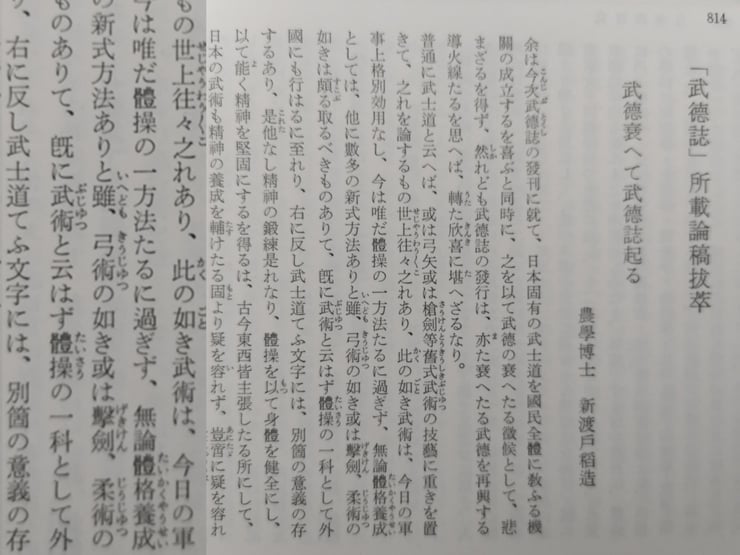
The photograph shown here appears to be from an article written by Nitobe Inazō to commemorate the publication of “Butokushi.” In that image as well, the characters “撃劍” are provided with furigana reading “gekiken.”
However, it is possible that this reading was introduced by Ichirō Watanabe when reproducing the text. With that in mind, I attempted to locate the original source.
Unfortunately, I was unable to find the original version of Nitobe Inazō’s text online. However, I did manage to locate another article from the same journal, “Butokushi.”
Below is a photograph showing only the relevant excerpt.
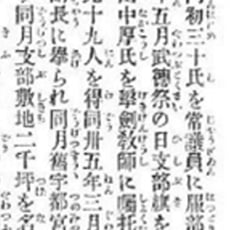
Butokushi, June 1906 (Meiji 39).
In the center, the text reads “Gekiken Kyōshi” with furigana indicating the pronunciation “gekiken kyōshi.”
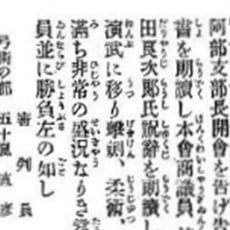
Butokushi, July 1906 (Meiji 39).
The text reads: “Moving on to the martial demonstration, Gekiken (gekiken), jūjutsu (jūjutsu).”
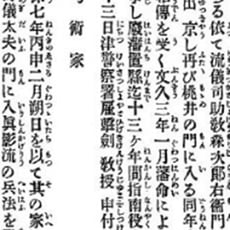
Butokushi, August 1906 (Meiji 39).
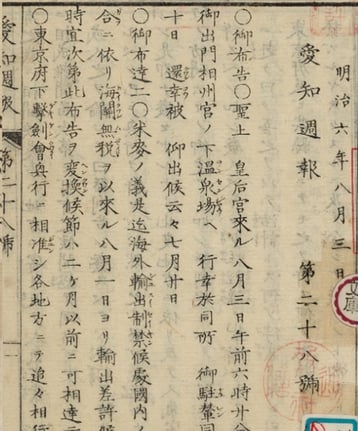
The text reads: “Tsu Police Station Employed Gekiken Instructor (tsu keisatsusho yatōi gekiken kyōju),” with the reading “gekiken” clearly indicated.
From these examples alone, it cannot be definitively stated that “gekiken” was the universal reading at the time. However, it is clear that within the Dai Nippon Butokukai, the term “撃剣” was read as “gekiken.”
It is also possible to find other books from the Meiji and Taishō periods in which the reading “gekiken” is explicitly indicated.
Butokushi, June 1906 (Meiji 39).
In the center, the text reads “Gekiken Kyōshi” with furigana indicating the pronunciation “gekiken kyōshi.”
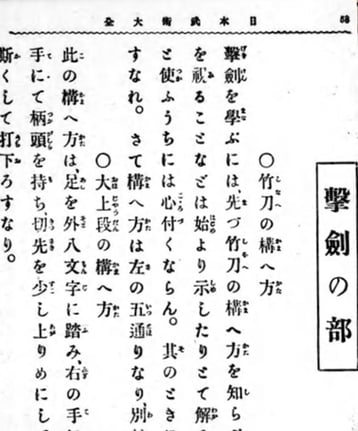
Butokushi, June 1906 (Meiji 39).
In the center, the text reads “Gekiken Kyōshi” with furigana indicating the pronunciation “gekiken kyōshi.”
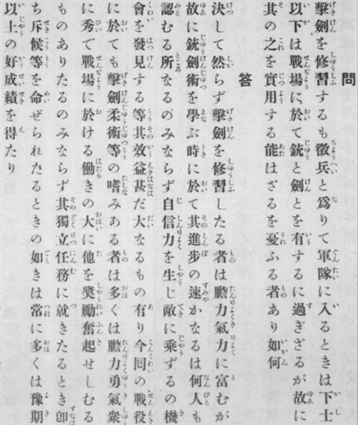
Nogi Taishō Bushidō Mondō, Taishō 2 (1913).
In this collection of questions and answers on bushidō addressed to General Nogi, who is also known in connection with Nogi Shrine and Nogizaka, the term “撃剣” is likewise provided with the reading “gekiken.”
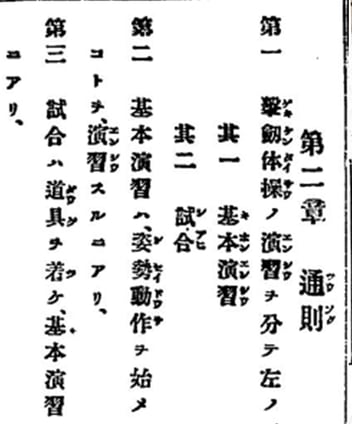
In “Shin’an Gekiken Taisōhō,” which we also introduce on our website, the term “撃剣” is likewise given the reading “gekiken.”
If one searches, it seems that examples using the reading “gekiken” appear in abundance.
That said, in some novels from the same period, the reading “getsuken” can also be found. For that reason, it may not be a simple matter of declaring one reading correct and the other incorrect.
It is possible that in spoken language the word was pronounced “gek-ken,” or at least perceived that way. Even when consciously pronouncing it as “gekiken,” the consonant can tighten in speech so that it sounds like “gek-ken.” We ourselves do not feel the need to correct someone if, in conversation, it happens to sound that way.
This observation as well gave us an opportunity to revisit the issue, and in doing so, certain previously ambiguous points became clearer.
Once again, I would like to express my sincere gratitude.
Going forward, if errors or discrepancies in terminology or understanding are discovered, we intend to review and correct them as appropriate.